What we were working with
Lake Sylvia sits southwest of Annandale in western Wright County, two lakes joined by a channel and among the deepest in the county. Like most lakes in this part of the state, its banks take a beating from three directions. Waves work at the toe of the slope all summer. Ice pushes against the shore in spring. Rain and snowmelt run down the hill from the house and carry soil with them.
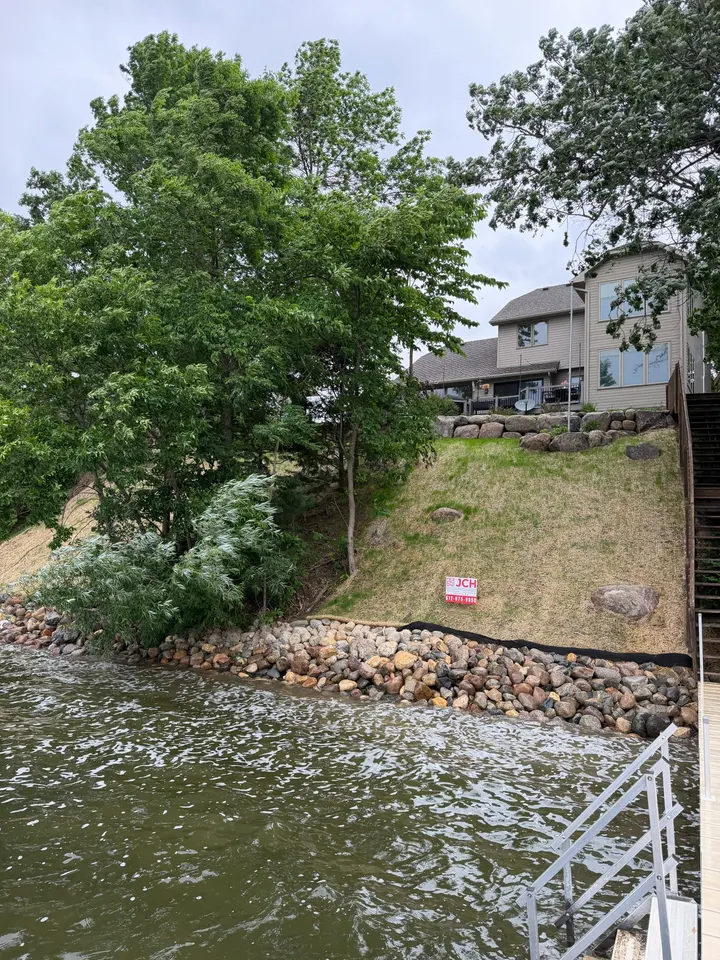
On this lot all three had been at it for years. The bank was steep, bare, and actively slumping toward the water. There was no vegetation holding it and nothing at the waterline to absorb the wave energy. Every storm took a little more, and the yard above was slowly following it down.
What we built
We treated the bank as two problems. The first was the toe of the slope at the waterline, and the second was the hillside above it.
We brought in a compact excavator to work the slope. A small machine matters on a lake lot. It can reach the bank without tearing up the rest of the yard, and it lets us cut the grade precisely instead of pushing dirt around. We shaped the hillside to a stable angle and cut in a base for the wall.
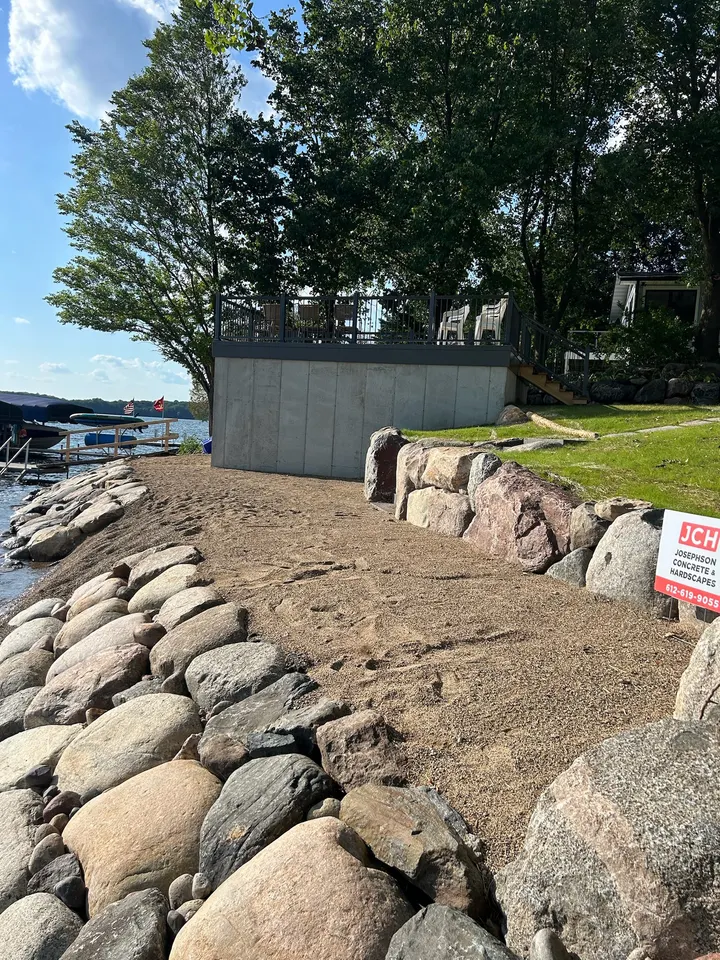
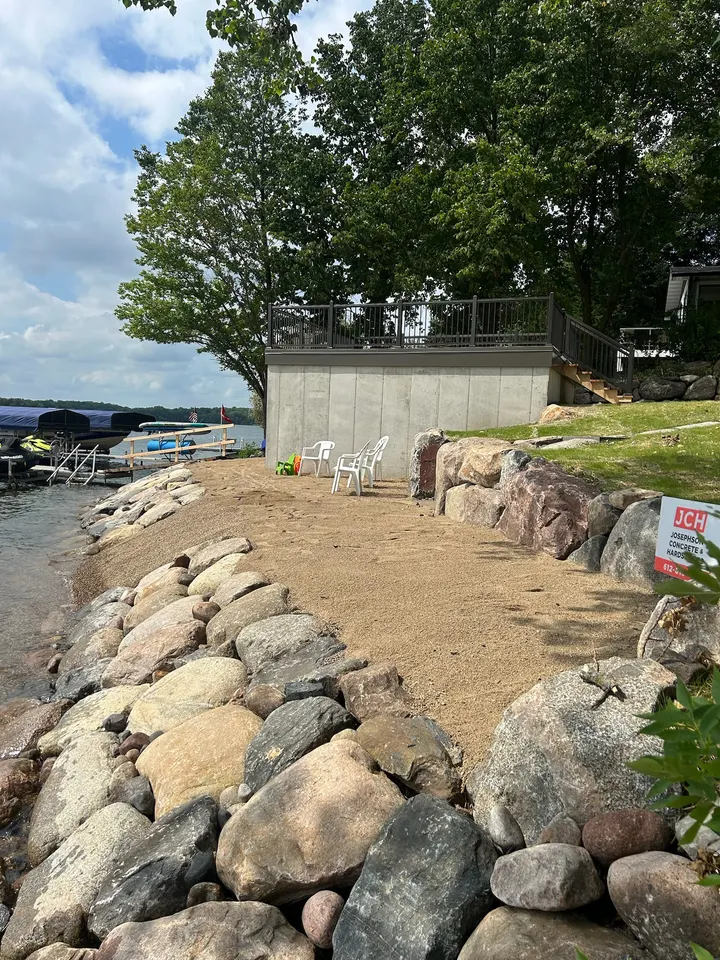
The shoreline went in first. We packed rounded fieldstone tightly along the water’s edge as riprap. Riprap works by giving waves something rough to break against instead of a soft soil face, and the gaps between stones let water in and out without carrying soil with it. Holding the toe is what keeps the rest of the slope from sliding.
From there we worked uphill with large natural boulders, setting them into a retaining wall that leans back into the hill and carries the weight of the soil behind it. Boulder walls are sized by the job. These are not decorative rocks placed on the surface. Each one is seated into the bank so the mass of the stone does the holding.
Above the wall, we finished the slope with topsoil and seed. Once the grass roots in, the upper hillside holds itself and the wall and riprap only have to handle the water.
Why it will last
Erosion compounds. A bank that loses a foot this year loses more the next, because the slope gets steeper each time. Stopping the cycle at the toe with riprap and holding the mass of the hill with boulders breaks that pattern.
The materials also fit the setting. Granite fieldstone and natural boulders look like they belong on a Minnesota lake, and they do not need paint, sealant, or replacement. Shoreline work on public waters usually involves the DNR and the county, and we will walk you through what that looks like before we start.
We build shoreline, boulder retaining walls, and drainage and erosion control on lakes across Wright and Meeker counties.