
Grading away from the foundation on clay
The first fix is almost always the cheapest one: the ground next to the house has to fall away from it. On newer homes the backfill around the foundation settles for a couple of years and ends up sloping back toward the wall, holding water against the block right where the frost is. We regrade with clay or a clay-topsoil mix, pitched down and away for the first several feet, then sod or seed it. We do not bury the problem under mulch or rock without fixing the slope underneath. On lots where the house sits in a low spot and there is nowhere for the grade to go, we pair the regrade with a swale or a pipe.
Drain tile, downspout runs, and where the water actually goes
Downspouts that dump at the corner of the house put a roof's worth of water into the clay next to the footing. We run them underground in solid pipe to a pop-up, a rock bed, or daylight on the low side of the lot. Where the yard stays wet, we trench perforated drain tile in a bed of washed rock wrapped in fabric to pick up subsurface water and carry it out. The pipe only works if it has somewhere to go, so every plan starts with the outlet: a ditch, a low corner, a rain garden, or a rock bed, and it has to be lower than the wet spot. On a flat clay lot, finding that outlet is sometimes the whole puzzle.
Swales, rock beds, and sloped lots
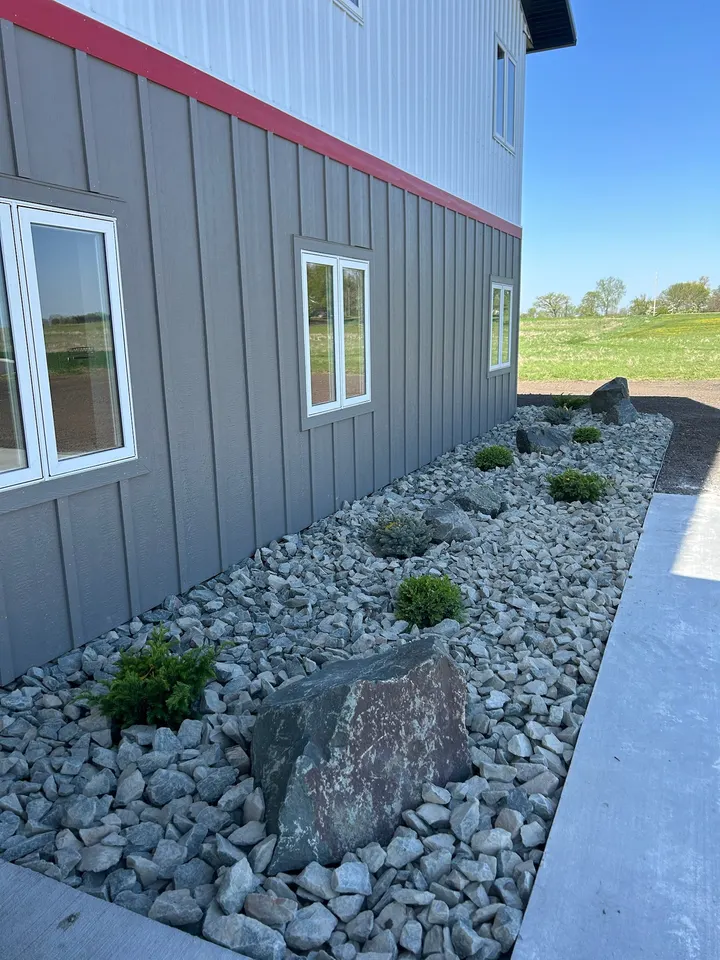
A swale is a shallow, wide, grassed channel that carries runoff across a slope instead of letting it pick a path on its own. It is the right tool on a lot that drops toward the lake, a neighbor, or the driveway. Where water moves fast enough to cut, we line the low point with river rock over fabric so it slows down and stays put. Rock beds along a foundation do the same job at a smaller scale: they take the splash off the roof line, keep soil from spattering the siding, and give downspout water a place to spread. Boulder edges and low walls hold the top of a slope so the swale below stays where we built it.
Erosion on new-construction dirt
A freshly graded lot with bare clay is the worst case. One heavy rain moves a season's worth of soil into the street, the lake, or the neighbor's yard, and the gullies it leaves are hard to fix once the sod is down. On new builds we set the final grades, cut the swales, install the downspout runs, and then cover the dirt with seed and erosion blanket or sod so roots take over before the next storm. Where the lot slopes toward water, we hold the toe with boulders or a small wall first. Doing it in that order, before the lawn goes in, costs a fraction of tearing up a washed lawn later.
What drives the cost of drainage and erosion work
Drainage is priced by where the water has to go and what is in the way, not by the size of the wet spot.
- How far the water has to travel to reach a workable outlet that is lower than the problem.
- Whether the fix is regrading only, or trenching for drain tile and solid pipe.
- Amount of soil that has to be brought in or moved to correct the grade.
- Length of swale and how much rock it needs to hold at the speed the water runs.
- Access for a machine versus hand digging next to the house, the septic, and buried utilities.
- Restoring what we cross: sod, seed, erosion blanket, and any hardscape we lift and reset.
When we would talk you out of it
- Water coming through the basement wall or up through the floor drain. That is interior waterproofing and a sump system, a different trade. We will fix the grade and downspouts outside, which is where most of that water starts, and tell you when the rest is inside work.
- A lot with no outlet: flat clay, neighbors on every side, and nowhere lower to send the water. Pipe does not help if it cannot drain. We will talk through a rain garden or a dry well instead, and be honest if neither will keep up.
- Erosion on a lake bank at the water. That is shoreline work under DNR and county shoreland rules, with riprap and a filter layer, not a yard drainage fix. We will quote it from the shoreline side.
What you get
- Grade pitched away from the foundation so water leaves the wall
- Downspouts piped underground to a real outlet, not the corner of the house
- Drain tile in washed rock and fabric where the yard stays wet
- Swales and rock beds sized for how fast the water actually moves
- Erosion blanket and seed on bare dirt before the first big storm
- Built by the same crew that pours the slabs and sets the walls it protects
How it goes
- 1
Call and tell us where the water shows up
A wet basement corner, a soft spot, a washed bed. Photos taken during or right after a rain tell us more than anything else.
- 2
Site visit, ideally when it is wet
We walk your lot, read the grades, find the outlet, and see where the roof and the lawn actually send their water.
- 3
Written plan with the outlet named
You get a scope that says where the water goes: regrading, pipe runs, tile, swale, rock, and what we restore afterward.
- 4
Build, restore, and check it in the rain
We grade, trench, pipe, rock, and seed or sod. The next real rain is the test, and we want to hear how it did.
Questions we get asked
Why does my yard stay wet for days after it rains?
Because the soil around Cokato is clay-heavy glacial till, and water does not soak into clay. It sits until it runs off or evaporates. If the grade is flat or holds a low spot, the water has nowhere to go. The fix is usually surface drainage: regrading, a swale, or drain tile with a real outlet that sits lower than the wet spot. We find that outlet first, then design backward from it.
How far should the ground slope away from my house?
The rule we work to is a steady fall away from the foundation for the first several feet, with no dip that catches water against the wall. On clay backfill that has settled, that often means bringing in soil and rebuilding the slope, then seeding or sodding it so it stays put. Downspouts should discharge well past that zone, not at the corner of the house where the backfill is softest.
Do I need drain tile or just regrading?
Regrading fixes most surface water problems and costs less, so we start there. Drain tile makes sense when the ground itself stays saturated, when a low spot cannot be graded out, or when water collects behind a wall or next to a slab. Either way the water needs an outlet lower than the problem, and we find that before we recommend either one.
Can you fix erosion on a new-construction lot before the sod goes in?
Yes, and that is the best time to do it. We set the final grades, cut swales, run the downspouts underground, hold any slope toward water with boulders, and cover the bare clay with seed and erosion blanket or sod so it does not wash in the first storm. It is far cheaper than repairing a washed lawn and refilling gullies later.
Will a rock bed along the foundation solve water against the house?
Only if the grade under it slopes away. Rock over a flat or reverse-sloped grade just hides the problem while water keeps sitting against the wall. We regrade first, lay fabric, then set river rock so the bed takes the roof splash and lets downspout water spread and move out. Done that way it also keeps the siding clean and the soil from spattering.
Related work
Where we do this work
Drainage and erosion across western Wright County and the towns around Cokato: Howard Lake, Delano, Watertown, Cokato, Dassel, Annandale, Maple Lake, Buffalo, and the lake roads between them. See the full service area.