
Paver, flagstone, stepping stone, or concrete
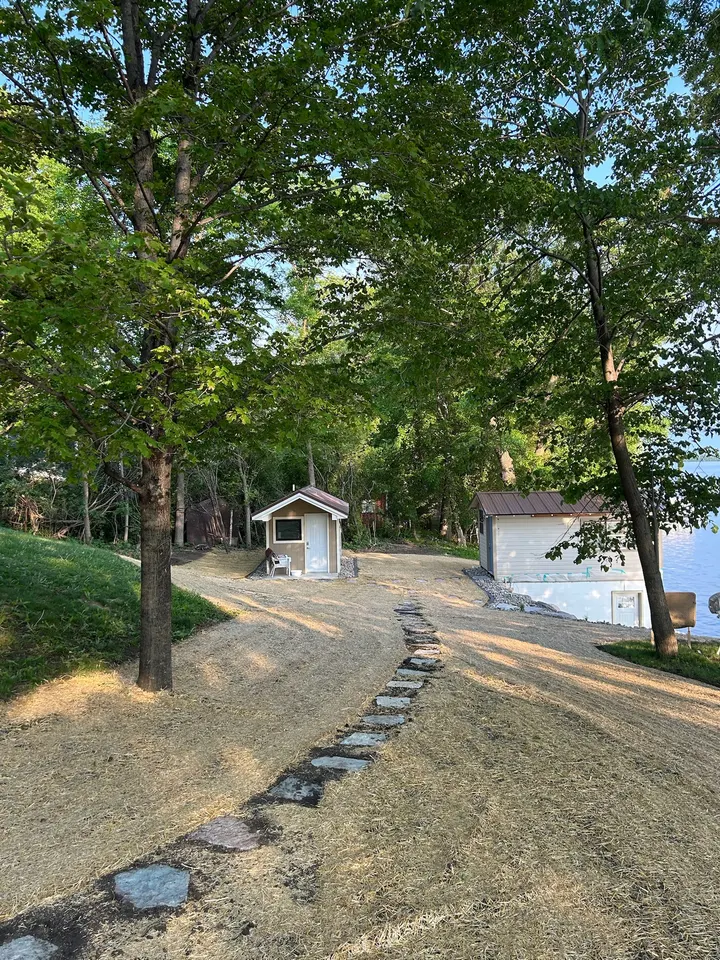
A front walk that gets shoveled all winter wants a solid surface: pavers, flagstone, or a broom-finish concrete walk. Pavers give you a border and pattern that can match the driveway apron. Flagstone gives a natural look that suits older homes and stone foundations. Concrete is the least expensive and the easiest to shovel, and we pour it with a broom finish for grip. For a path across a lawn or down a lake slope, stepping stones set into seeded ground or crushed rock are often the right call. We set them on a bed of compacted aggregate, spaced for a normal stride, so they do not rock or sink. One we built runs in a gentle curve down a graded slope past a small shed toward a boathouse at the water.
- Pavers or flagstone for the front walk, on a compacted base with edge restraint
- Broom-finish concrete for the cheapest shovel-friendly walk
- Stepping stones on aggregate for lawn and lake paths
Width, pitch, and where the path goes
Most walks fail on width before they fail on anything else. A 3-foot walk is a single-file walk. We build front walks 4 feet wide or wider so two people can pass and a snow blower fits in one pass. Cross pitch is about a quarter inch per foot so water runs off the side and does not sit and freeze. Along the length, we follow the grade with the walk and add a step only where the slope gets steeper than a walk should be. On a lake lot, the path takes the long way at a grade you can carry a cooler down, rather than the straight shot that turns into an ice slide in December.
Edging and lights along the walk
Pavers and flagstone get a spiked edge restraint on both sides so the outside units do not drift into the lawn. Where the walk borders a planting bed, we often run a soldier course or a steel edge to hold mulch and rock off the surface. If you want path lights, this is when to do it. We lay low-voltage wire under the base before the stone is set, so no one has to pull up a finished walk later to add a fixture. That work is covered on the landscape lighting page.
What drives the cost of a walkway
Walks are priced by length and width, then adjusted for what the site adds.
- Length and width, which set square footage
- Material: concrete, pavers, flagstone, or stepping stones
- Curves and cuts versus a straight run
- Steps or a landing where the grade gets steep
- Removing an old walk or cutting through a slab
- Lighting wire and fixtures added during the build
When we would talk you out of it
- A narrow path you just want to stop being muddy: a strip of crushed rock with a steel edge does the job for much less
- A walk on a slope steeper than about one foot of drop in eight: that needs steps, and our steps page covers it
- A temporary path for a construction season: rent mats or lay gravel, and build the real walk after the heavy trucks are gone
What you get
- Four foot or wider front walks
- Quarter inch per foot cross pitch
- Compacted aggregate under every material
- Edge restraint on pavers and flagstone
- Stepping stones set on base, not soil
- Lighting wire run before stone is set
How it goes
- 1
Call or send the form
Tell us where the path starts and ends and what it needs to survive: shovels, wheelbarrows, a cooler to the dock.
- 2
Site visit
We walk the route, shoot grades, look for spots that need a step, and check for downspouts that dump on the path.
- 3
Written quote
Material, width, base, edging, and any steps or lights as separate lines.
- 4
Build and clean up
Excavate, base, set, edge, and sweep. Lawn edges raked and ready for seed.
Questions we get asked
How wide should a front walkway be?
At least 4 feet. That lets two people walk side by side, a wheelbarrow or stroller pass without stepping into the lawn, and a snow blower clear it in one pass. A 3-foot walk feels narrow the first time guests arrive. Side-yard and garden paths can be narrower, around 3 feet.
Which walkway material is easiest to shovel?
Broom-finish concrete, then pavers with a flat face, then flagstone. Concrete has no joints for a shovel edge to catch. Pavers are close when set flush. Flagstone has slight height differences between stones, so a plastic shovel or a snow blower on skid shoes works better than a steel blade.
Do stepping stones need a base or can they sit in the dirt?
They need a base. A stone set on soil rocks, sinks on one side, and grows a lip that trips people. We dig each spot, add a few inches of compacted aggregate, and set the stone on it. Then they stay flat and the mower or string trimmer can run over the edges.
Can you run a path down a lake slope to the dock?
Yes. We grade a route at a walkable pitch, set stepping stones or a paver walk on compacted base, and add boulder steps where the slope gets steep. Where the path reaches the water, shoreline rules apply, and that side of the job is covered on our shoreline page.
Related work
Where we do this work
Walkways and paths across western Wright County and the towns around Cokato: Montrose, Cokato, Dassel, Howard Lake, Annandale, Maple Lake, Buffalo, Delano, and the lake roads between them. See the full service area.