
Block bases, veneer, and counters
An outdoor kitchen base is a concrete block structure laid on a slab or a compacted paver pad, with openings framed for the grill, a side burner, a door, or a refrigerator. Over the block goes a veneer: cut natural stone, thin stone veneer, brick, or a stucco finish, matched to the house or to the patio walls. The counter is the part you touch every day. Granite and other dense natural stone hold up best outside in Minnesota, because they shed water and do not care about freeze and thaw. Poured concrete counters work too and can be formed to any shape, and we seal them. Grill cutouts are cut to the manufacturer's spec for the model you buy, with the ventilation the grill needs, so buy or pick the appliances before we lay block.
- Concrete block base on a slab or compacted paver pad
- Stone, brick, or stucco veneer matched to the house or patio
- Granite or sealed concrete counters
- Cutouts and venting built to the appliance spec
Gas, electric, and water: who does what
We build everything you can lean on. A licensed gas fitter runs the gas line and connects the grill. A licensed electrician runs the circuit for outlets, a refrigerator, and lights. A licensed plumber runs and connects any water line and drain. We coordinate the sequence so the trenches are open when the trades need them and closed before the pavers go down, and we leave the chases and sleeves in the block so their lines pull through cleanly. If you already have a plumber or electrician you trust, we work with them.
Covered or open, and what winter does to it
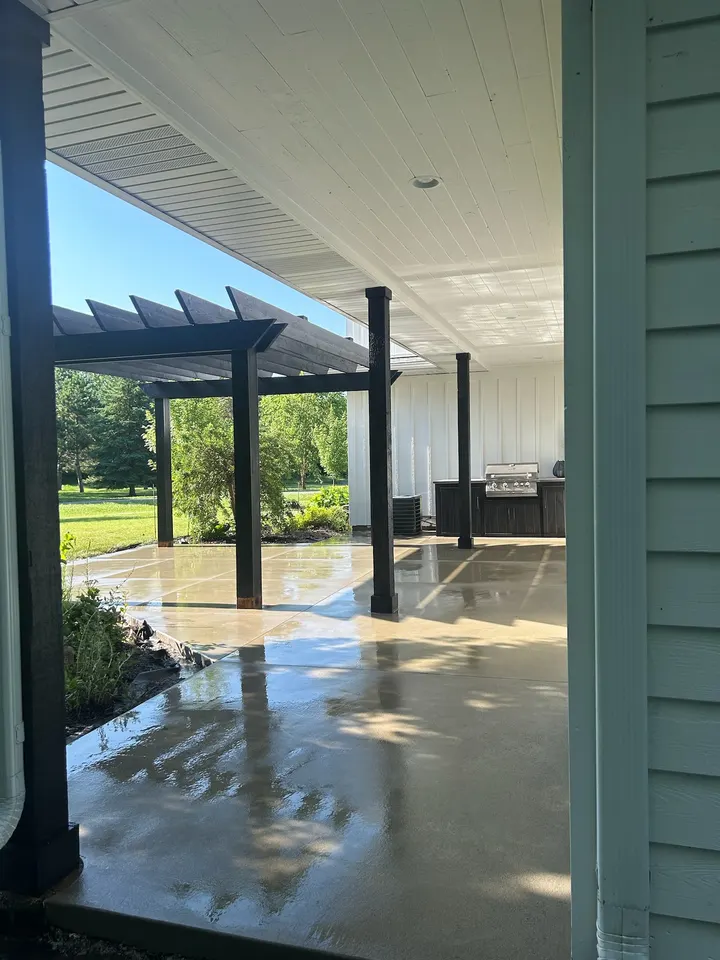
A kitchen under a roof, a covered patio, or a pergola gets used more and lasts longer. Appliances stay drier, the counter is out of the sun, and you can cook in a rain. We have built on covered patios with sealed concrete floors where the grill station sits against the back wall under the roof. An open kitchen works fine too, with appliance covers and a plan for winter. In either case, water lines get drained and blown out before frost, gas gets shut off at the valve, and the refrigerator comes inside or is winterized. The masonry itself does not care about winter if it is built on a proper base, and the counter joints are sealed so ice does not get into them.
What drives the cost of an outdoor kitchen
The appliances are your budget. The build is ours, and these are the factors that move it.
- Linear feet of counter and the number of cutouts
- Veneer: thin stone, full cut stone, brick, or stucco
- Counter material: granite or poured concrete
- Which utilities you want and the trades' trenching
- Whether the patio or slab under it is new or existing
- A roof, pergola, or cover added over the kitchen
When we would talk you out of it
- A grill you roll out three times a summer: a paver pad and a quality cart grill make more sense than a built island
- A kitchen on a deck or any surface that has not been checked for the weight of block and stone: we would move it to a slab or pad on grade
- A build with no utilities budgeted: the licensed trades' work is separate from ours, and it is worth pricing before deciding on gas versus propane
What you get
- Block base, veneer, and counter from one crew
- Built on the patio or slab we also build
- Cutouts to the appliance manufacturer's spec
- Gas, electric, and water by licensed trades we coordinate
- Granite or sealed concrete counters that take frost
- Chases and sleeves left in the block for clean runs
How it goes
- 1
Call or send the form
Tell us where the kitchen goes, what appliances you have in mind, and whether it is on a new or existing patio.
- 2
Site visit
We measure, check the base, find the gas and electric sources, and sketch a layout with counter length and cutouts.
- 3
Written quote
Masonry, counters, and pad quoted by us, with the licensed trades' scope listed so you can price it alongside.
- 4
Build and clean up
Pad, block, sleeves, trades in, veneer, counter, appliances set. Then dinner.
Questions we get asked
Do you run the gas and electric for the outdoor kitchen?
No. We build the pad, block base, veneer, and counters, and leave chases in the block. A licensed gas fitter, electrician, and plumber run and connect their lines, and we schedule the sequence so trenches are open when they need them. You can use your own trades or ones we work with regularly.
What counter material lasts outside in Minnesota?
Granite and other dense natural stone hold up best. They shed water, resist stains, and do not crack in freeze and thaw. Sealed poured concrete is a good second choice and can be formed to any shape. We avoid tile and laminate outdoors, because water gets into the joints and ice breaks them apart.
Should I pick the grill before you build?
Yes. Every built-in grill has its own cutout size and ventilation needs, and the block opening has to match. Pick the grill, side burner, doors, and refrigerator first, and send us the spec sheets. Building the base and then shopping for a grill that fits is the wrong order.
Can an outdoor kitchen go on an existing paver patio?
Often, yes, if the base under it is sound. Block and stone are heavy, so we check that the pavers are on compacted aggregate and not settling. Where the base is thin, we pull the pavers in that footprint, pour a small slab or compact a new pad, and reset the pavers around the finished base.
Related work
Where we do this work
Outdoor kitchens across western Wright County and the towns around Cokato: Cokato, Dassel, Howard Lake, Annandale, Maple Lake, Buffalo, Delano, Hutchinson, and the lake roads between them. See the full service area.