
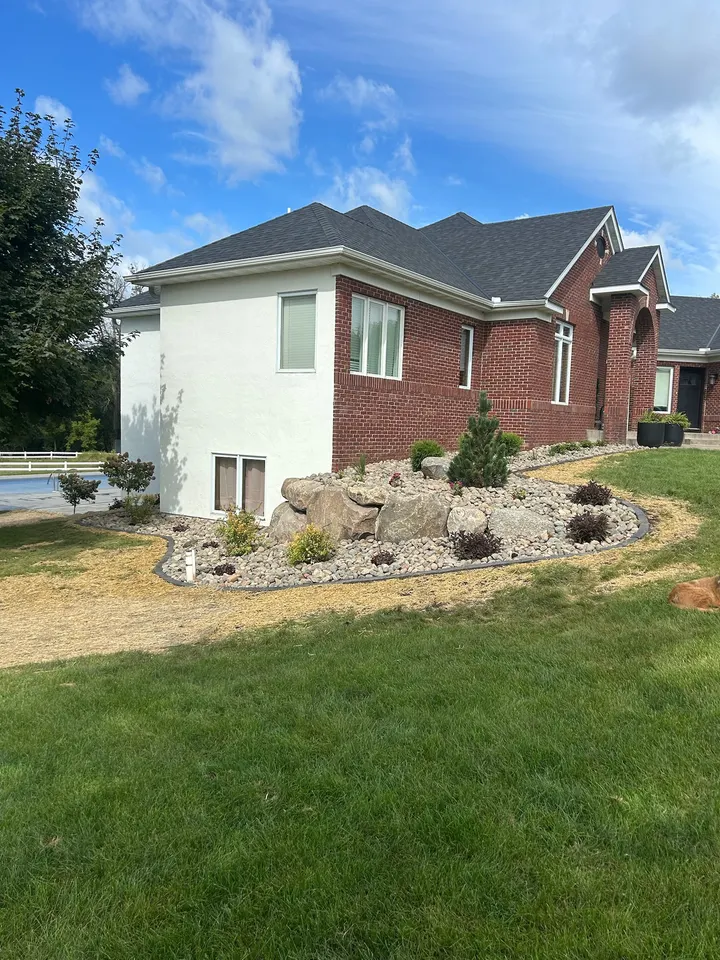
Beds, mulch, and rock: what goes where
Every bed starts with a clean edge and a base that drains. We cut the bed line, pull the sod, and grade the bed so water moves through it and away from the house. Then the surface goes on. Mulch is the warm, quiet choice for beds with plantings; it holds moisture, keeps weeds down, and needs topping up every year or two. Decorative rock is the low-upkeep choice, and it is what we use against foundations, along the base of a wall, and anywhere water comes off a roof edge, because it does not wash away and does not rot. Under rock we lay a woven fabric so it stays clean; under mulch we usually skip the fabric so the plantings can spread and the bed can breathe. Boulders go in as accents and as bed corners that mowers will not chew up.
- Mulch beds for perennials, shrubs, and foundation plantings
- Decorative rock: river rock, trap rock, and granite in the sizes that stay put
- Boulder accents set into beds, not dropped on top of them
- Fabric under rock, bare soil under mulch, on purpose
Plantings that survive here
We plant what lives through a Wright County winter without babying: hardy shrubs, native grasses, and perennials that come back on their own. We set plants for the size they will be in five years, not the size they are in the pot, so the bed does not turn into a hedge. Around a patio or fire pit that means low growers near the sitting area and taller screening where you want privacy from the neighbor or the road. On a lake lot we lean toward deep-rooted natives on the slope above a wall, because roots are what hold that bank once the rock has done its job at the water.
Edging, seed, and sod
An edge is what keeps a bed looking like a bed. We use steel edging where you want a crisp line that disappears, and a paver soldier course where the bed meets a paver patio so the two read as one build. Where we graded to build a wall or a slab, we finish the disturbed ground with topsoil and seed, or sod when you want it green this season. We match the seed to the yard: a sun mix in the open, a shade mix under the trees, and a slope mix with a quick-germinating cover on any bank we cut.
What drives the cost of landscaping work
Landscaping is quoted by the bed and by the yard, and these are the things that move the number.
- Square feet of bed, and whether it is new or a rebuild of an overgrown one
- Mulch versus rock, and the size and type of rock
- Plant count and size: a three-gallon shrub costs more to buy and to plant than a one-gallon
- Boulders, which are priced by the ton and by how far the machine has to carry them
- Edging type and length
- Seed versus sod on the ground we graded, and how much of the yard that is
- Whether we are finishing our own hardscape job or coming in fresh to an existing yard
When we would talk you out of it
- A yard that needs mowing, pruning, or seasonal maintenance. We install; we do not maintain. We can point you to someone who does.
- A full garden design with a plant list a hundred lines long. We keep plantings simple and hardy; a landscape designer is the right call for that.
- Tree removal or tree planting bigger than a nursery pot. That is a tree company with the right equipment.
What you get
- The yard is finished when the hardscape is finished, by the same crew
- Beds graded to drain, so mulch stays put and foundations stay dry
- Rock where water hits, mulch where plants live
- Hardy plantings sized for five years out
- Edging that keeps beds and lawn from growing into each other
- Seed or sod on every square foot we disturbed
How it goes
- 1
Walk your yard
We look at what is there, where the water goes, and what you want to see from the house, and we sketch the beds while we are standing in them.
- 2
Written quote by the bed
Each bed, the plant list, mulch or rock, edging, and the seed or sod area are line items, so you can trim or add before we start.
- 3
Cut, grade, and set
Bed lines cut, sod pulled, beds graded, edging set, boulders placed, plants in, then mulch or rock over the top.
- 4
Finish and hand off
Seed or sod on the disturbed ground, a watering schedule for the first month, and the truck leaves with the mess.
Questions we get asked
Do you do landscaping on its own, or only with a concrete or hardscape job?
Both. Most of our landscaping is the finish work on a patio, wall, or driveway we built, because the beds and the grading are already part of that job. We also take standalone bed rebuilds, rock beds along a foundation, and seed or sod work around Cokato when it fits the schedule. Call and describe the yard.
Should I use mulch or rock in my beds?
Mulch where plants live and rock where water hits. Mulch holds moisture and feeds the soil but needs topping up every year or two. Rock is permanent and stays clean against a foundation, along a wall, and under roof edges, but it gets hot in July and plants in it need more water. Many yards use both.
What plants actually survive a Wright County winter?
Hardy shrubs, native grasses, and perennials rated for the cold here: things like dogwood, ninebark, spirea, hydrangea, sedum, and prairie grasses. We avoid anything that needs wrapping or digging up in the fall. We also set plants with room to grow so the bed still looks right in five years instead of overgrown in two.
Will you seed or sod the ground you tore up building my wall?
Yes, and it is on the quote from the start. Where we graded or drove equipment, we bring in topsoil, grade it smooth, and seed or sod it. Sod is green this season; seed costs less and fills in over a few weeks. On a slope we use a seed mix with a fast cover crop so the bank holds until the grass takes.
Related work
Where we do this work
Landscaping across western Wright County and the towns around Cokato: Buffalo, Delano, Montrose, Cokato, Dassel, Howard Lake, Annandale, Maple Lake, and the lake roads between them. See the full service area.