
What we pour
Most of our concrete work falls into a handful of jobs, and each one has its own page with the details. The short version of each is here so you can find the right one.
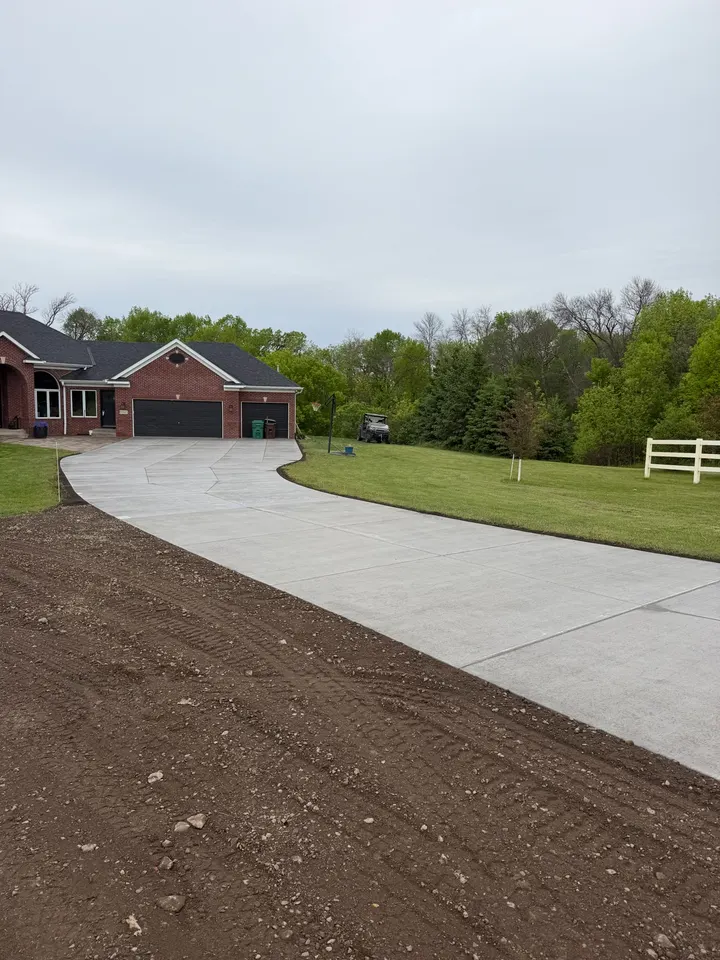
- Driveways: broom-finished, four inches for cars and thicker where trucks and trailers park, with aprons at the road and curves where the lot calls for them.
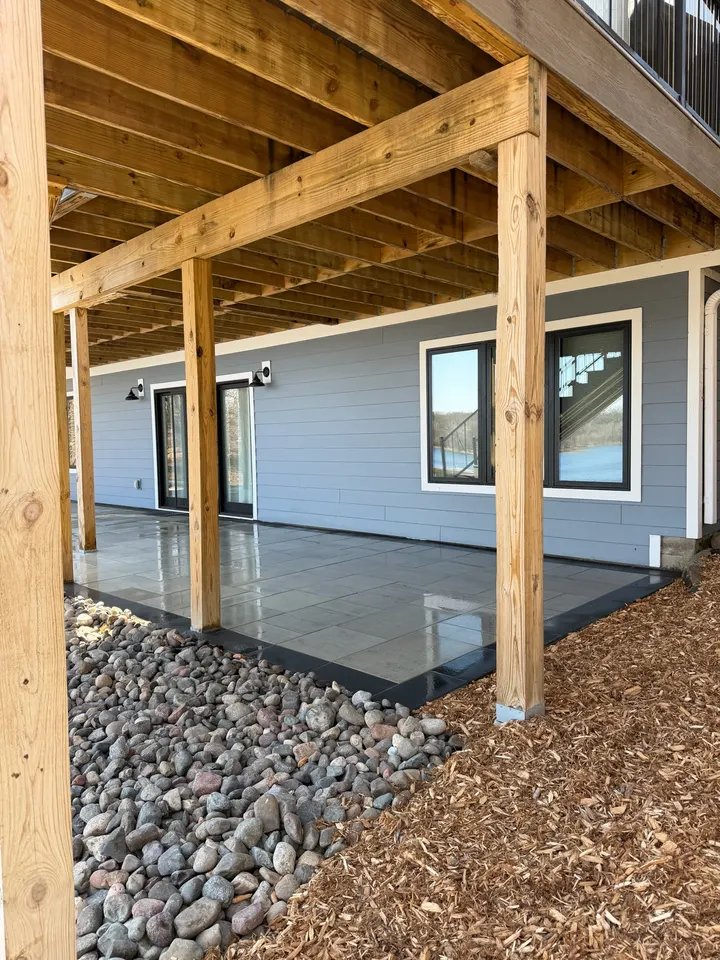
- Patios: poured slabs off the back of the house, pitched away from the foundation, plain broom or stamped, often with a paver border or a fire pit set into them.
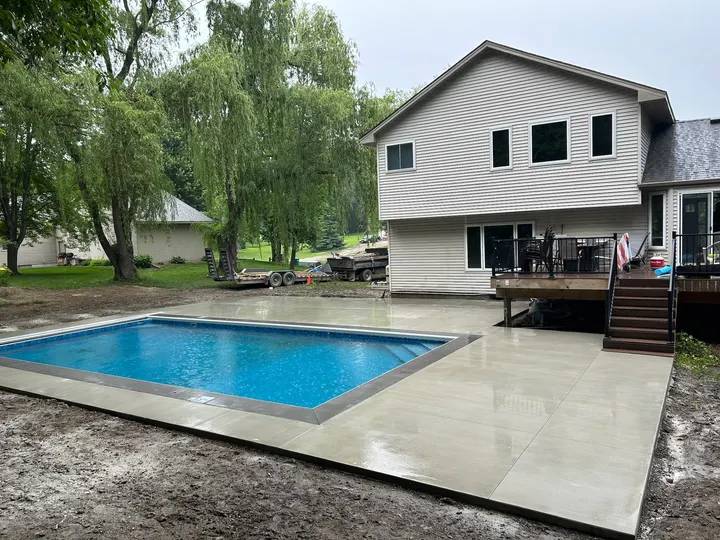
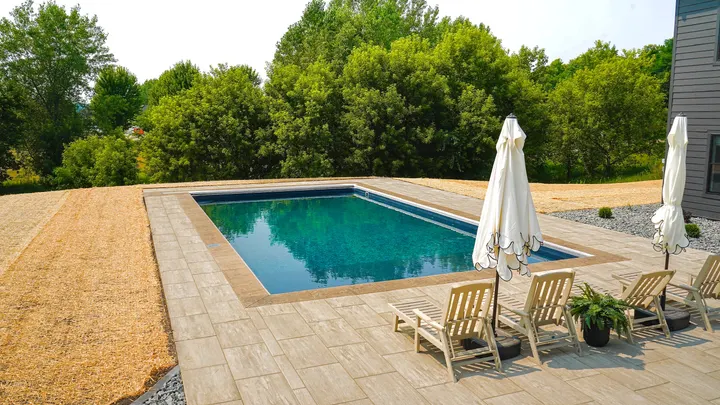
- Pool decks: broom-finished for bare feet, pitched away from the pool wall, with coping, an expansion joint, and paver soldier-course borders.
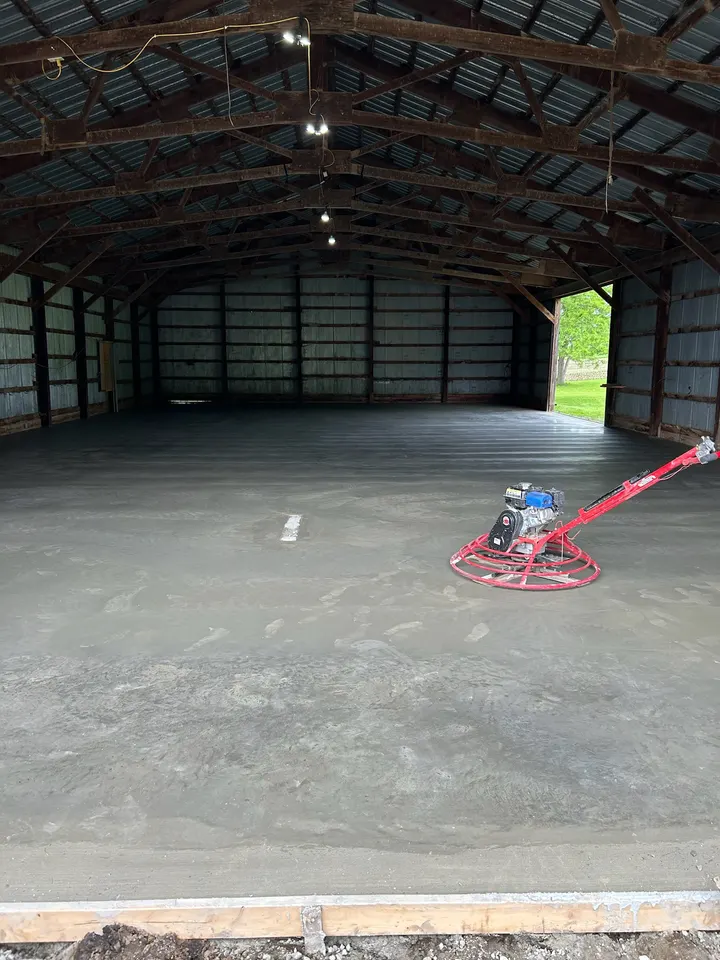
- Garage and shop slabs: thickened edges, vapor barrier where it belongs, floor drains, and coordination with in-floor heat tubing.
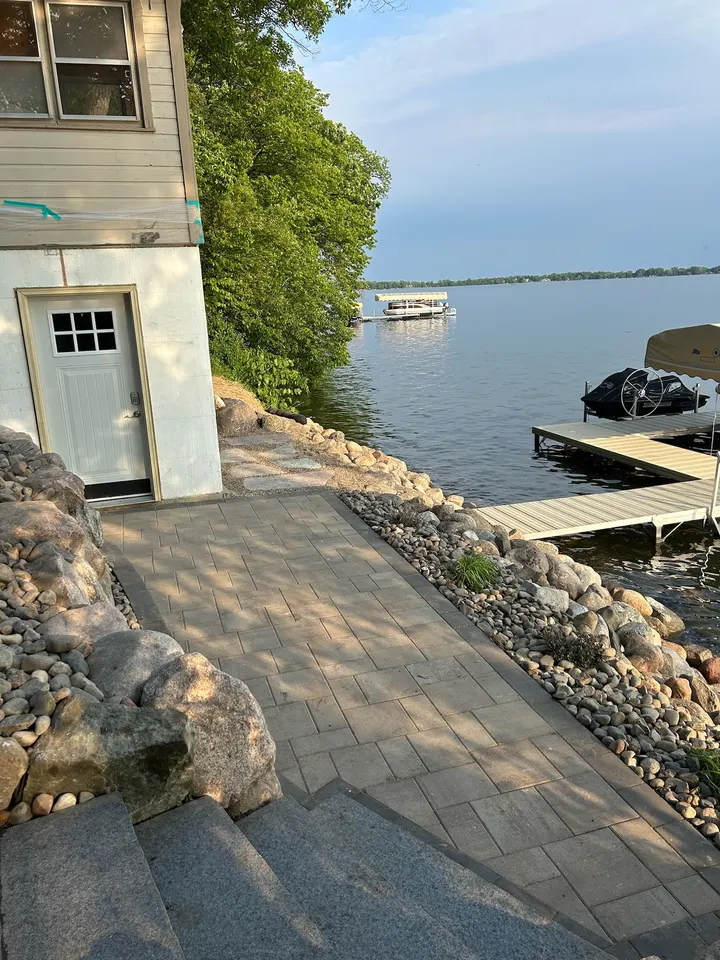
- Steps and stoops: poured concrete, paver, or boulder steps, on frost footings when they attach to the house, with risers that match.
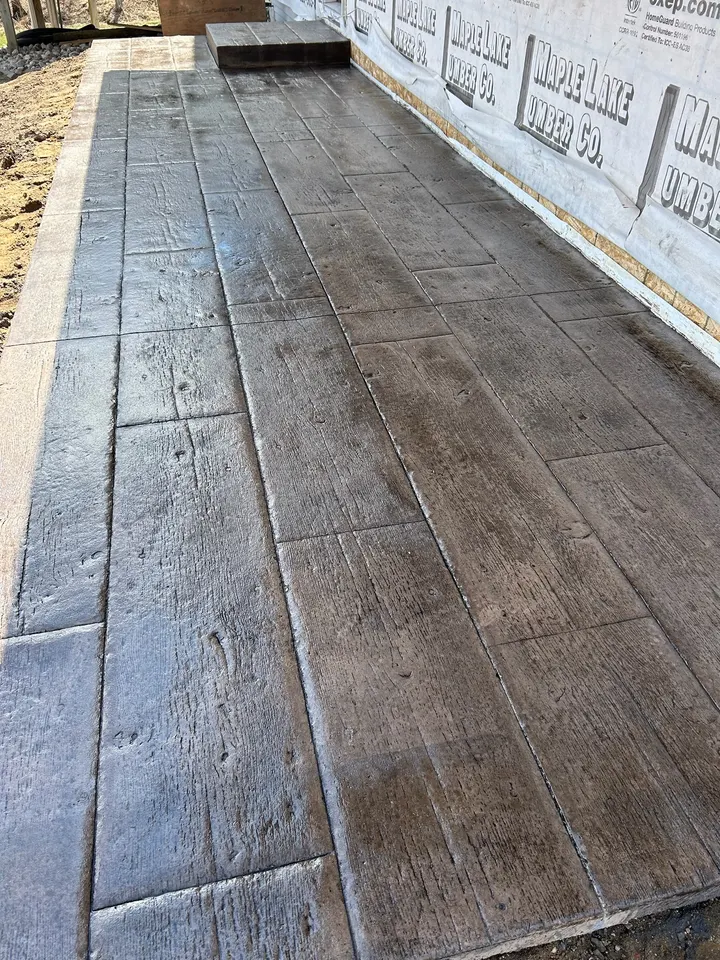
- Stamped and decorative: wood plank, stone, and slate patterns with integral or broadcast color, sealed after cure.
- Pads and slabs for sheds, saunas, hot tubs, and equipment, and sidewalks along buildings.
Why concrete fails in Wright County, and what we do about it
Concrete does not crack because it is weak. It cracks because the ground under it moves, water gets where it should not, or nobody told it where to crack. Around Cokato the ground is glacial till, clay-heavy soil that holds water and swells when it freezes. The county builds footings to a 42-inch frost depth for a reason: the frost goes deep here, and a slab sitting on wet clay rides up and down with it every winter. We deal with that in four places.
- Base. We strip the topsoil and any soft clay, then bring in a granular base, usually class 5 gravel, and compact it in lifts with a plate compactor. A slab on compacted gravel drains and moves a lot less than a slab on the dirt that was there. On bad soil we dig deeper and add more base rather than pour over the problem.
- Frost. Open flatwork does not sit on 42-inch footings, but anything attached to the house does. Steps against a foundation, stoops, and slabs that carry a post get footings or piers to frost depth so they stop heaving away from the door. For a floating slab, the answer to frost is drainage: a base that does not hold water has less in it to freeze.
- Water. Every slab we pour is pitched, usually about an eighth to a quarter inch per foot, so water runs off the surface and away from the house or the pool. Downspouts get extended past the slab. Where the yard sends water at the concrete, we grade or add drain tile before the pour, not after.
- Control joints. Concrete shrinks as it cures and it is going to crack. We saw-cut joints into the slab, usually the day after the pour, at spacing that matches the thickness, so it cracks along a straight line we chose instead of a jagged one it chose. Joints go at inside corners and around columns too, because that is where cracks start.
The mix, the cure, and the first winter
Exterior concrete in Minnesota needs an air-entrained mix. Tiny air bubbles in the concrete give freezing water somewhere to expand, and without them the surface pops and scales after a couple of winters. We order it that way for every outdoor pour. Curing matters as much. Concrete gets its strength from water reacting with cement over weeks, so we keep it damp or apply a cure-and-seal compound rather than letting a hot June afternoon dry it out. Stay off it on foot for a day, keep cars off a driveway for about a week, and expect it to keep gaining strength for a month. The first winter, skip the deicing salt. Sand for traction is fine. Salt on concrete that is under a year old is the fastest way we know to scale a new surface.
Finish options: broom, stamped, exposed aggregate, colored, sealed
The finish is decided before the truck shows up, because it changes the crew, the tools, and the timing of the pour. These are the five we do.
- Broom finish. The standard for driveways, walks, and pool decks. A stiff broom is dragged across the surface after floating, leaving fine lines that give traction when wet. Least expensive, most forgiving, easiest to repair.
- Stamped. Color goes into or onto the concrete, then rubber mats press a pattern in before it sets: wood plank, flagstone, slate, cobble. Looks like the material it copies from a few feet away. Costs more and needs sealing every two to three years.
- Exposed aggregate. The top layer of cement paste is washed off before it hardens to reveal the stone in the mix. Good traction, a natural look, hides dirt well. Rougher on bare feet than broom.
- Colored. Integral color mixed into the truck for a solid tone through the whole slab, or a broadcast hardener worked into the surface. Colored concrete can be broomed or stamped.
- Sealed. A penetrating or film-forming sealer applied after cure. Slows salt and water damage, deepens color, and is required on stamped work. Reapplied every few years.
What drives the cost of concrete flatwork
We quote each job from a site visit, and these are the things that move the number up or down.
- Square footage, and the shape. A long narrow walk costs more per foot than a square slab because of the forming.
- Thickness and reinforcing. A four-inch slab with fiber is the floor; six inches with rebar for trucks or equipment is a different pour.
- What has to come out first. Tearing out an old driveway or patio and hauling it away is real work before any concrete arrives.
- Base conditions. Soft clay or an old fill hole means more excavation and more gravel.
- Access for the truck. If the ready-mix truck can back up to the forms, we chute it. If it cannot, we wheelbarrow or pump, and that adds labor.
- Finish. Broom is the baseline. Stamped, exposed aggregate, and color each add material and crew time.
- Drainage and grading work around the slab, and anything on footings such as steps or stoops.
When we would talk you out of it
- A slab on fresh fill or a lot that was just graded. Unsettled fill sinks for a year or more and takes the concrete with it. We would rather you wait a season, or let us compact and build the base properly, than pour over it.
- Someone who wants it done in November. Concrete poured onto frozen ground or into a hard freeze does not cure right. We pour from roughly mid-April into October and we will tell you when the forecast says stop.
- A budget that only allows for a thin, unjointed, unreinforced slab. If the quote has to be cut that far, a compacted gravel pad or a paver surface may serve you better than concrete that cracks in two winters.
How it goes
- 1
Call or send the form
Tell us what you want poured and where. We will ask about access, what is there now, and how you plan to use it.
- 2
Site visit
We measure, check the grade and where water goes, look at the soil, and figure out where the truck can get to. Finish samples come along if you are deciding between broom, stamped, or exposed aggregate.
- 3
Written quote
You get a quote that lists thickness, reinforcing, base, finish, and joints, so you can compare it line by line with anyone else's.
- 4
Excavate, form, pour, cut, clean up
We strip and excavate, build and compact the base, set forms and rebar, pour and finish, saw-cut the joints, and haul away our mess. We tell you when you can walk and drive on it.
Questions we get asked
How thick should a concrete driveway or patio be in Minnesota?
Four inches of concrete on a compacted gravel base is the standard for a patio, sidewalk, or driveway that only sees cars. Where pickups, trailers, campers, or delivery trucks park, we go to five or six inches with rebar. Thickness matters less than the base under it; a thick slab on soft clay still heaves.
When can concrete be poured in Wright County?
Our concrete season runs from roughly mid-April into October, once the frost is out of the ground and before hard freezes come back. Early spring and late fall pours need blankets and a close eye on the forecast. We will not pour on frozen ground, because the base moves when it thaws and the slab settles with it.
Will my new concrete crack?
Yes, every slab cracks as it shrinks while curing. The job is to control where. We saw-cut joints at spacing matched to the slab thickness, the day after the pour, so the cracks run along those lines and stay out of sight. Random cracks usually mean missing joints, a soft base, or a slab that was loaded too soon.
Can you use salt on new concrete?
Not the first winter. Deicing salt pulls water into fresh concrete and the freeze-thaw cycles scale the surface. Use sand for traction that first year. After that, plain rock salt in moderation on air-entrained, sealed concrete is fine. Avoid deicers made with ammonium sulfate or ammonium nitrate, which attack concrete chemically at any age.
How long before I can drive on a new driveway?
Stay off it on foot for about 24 hours, keep cars off for about seven days, and keep heavy trucks off for at least a month. Concrete reaches most of its design strength in 28 days and keeps curing after that. Rushing it leaves tire marks in the surface and can crack the edges near the apron.
Where we do this work
Concrete flatwork across the towns around Cokato: Cokato, Dassel, Howard Lake, Annandale, Maple Lake, Buffalo, Delano, Hutchinson, Litchfield, Watertown, Winsted, Montrose. See the full service area.