What we were working with
The yard dropped away from the house, and the old retaining walls holding that slope were past their useful life. There was no real patio, only a strip of ground under the deck that nobody used. The homeowner had a good lot and a nice deck above it, but the space below was doing nothing.
Sloped yards are common on lake lots and on the rolling ground around Cokato, and they follow the same rule everywhere: the walls have to be fixed before anything pretty goes in front of them. A patio laid against a failing wall moves when the wall moves. So this job started with the walls, then the grading, and the flagstone came last.
What we built
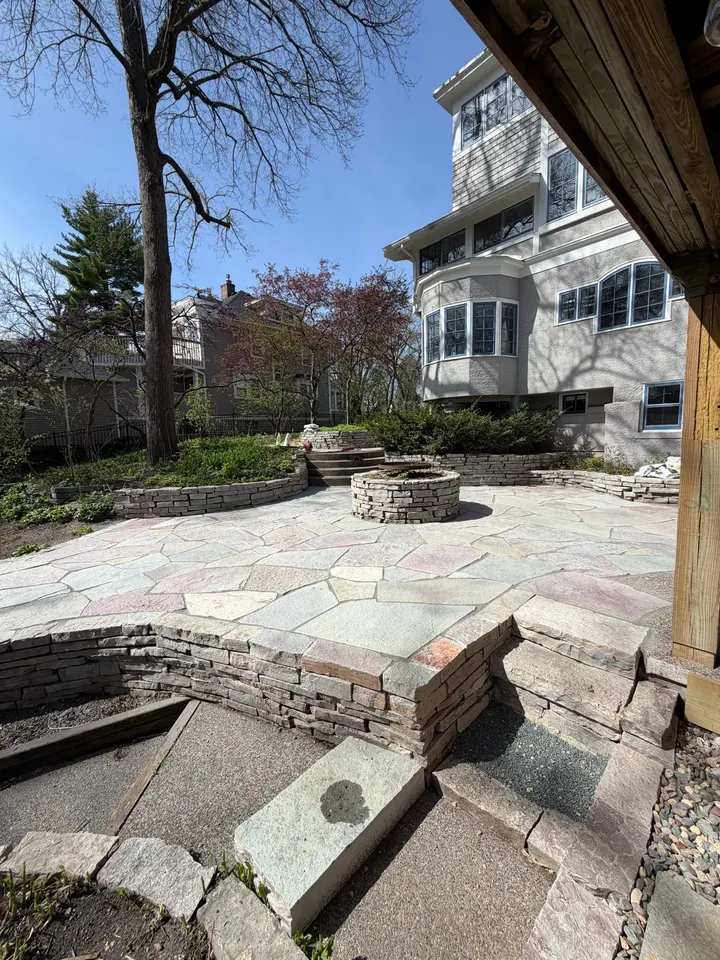
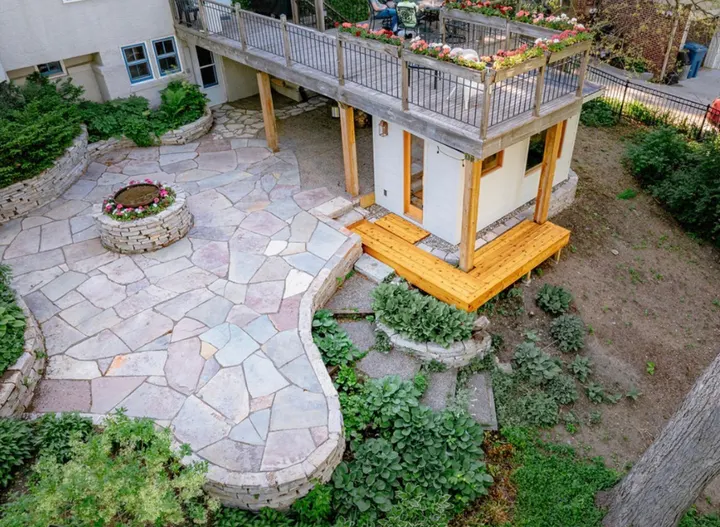
We took the old walls out and rebuilt them as dry-stacked natural stone. Dry-stacked means no mortar. Each course sits on the one below it, leaned slightly back into the hill, with drainage stone behind so water moves through the wall instead of pushing on it. The walls now frame the patio on more than one side and split the yard into an upper and a lower level that each feel like their own room.
The patio surface is Chilton flagstone. Chilton is a natural limestone with soft gray, tan, and pink tones, and no two pieces match. That variation is the reason people ask for it, and it is also what makes it slow to lay. Every stone gets cut and fitted by hand against its neighbors. We keep the joints tight and even so the pattern reads as planned rather than scattered, and so there are no wide gaps to collect ice and weeds.
In the middle of the patio we built a round fire pit out of the same stone as the walls. Matching the material keeps the fire pit from looking like an add-on. A set of stone steps ties the two levels together so you can walk from the deck stairs down to the fire pit without cutting through a planting bed.
Why it will last
Flagstone fails at the base, not at the surface. We set this patio on a compacted aggregate bed deep enough to ride out the frost heave that clay soil in this part of Minnesota is known for. The stones can lift a hair in February and settle back in April without cracking, because nothing is rigidly pinned.
The walls are built the same way. A dry-stacked wall drains on its own, so there is no hydrostatic pressure building up behind it in a wet spring. That is the difference between a wall that lasts and the ones we tore out.
The result is a backyard the household actually uses: a fire pit at the center, walls that define the space, and steps that make the grade change feel intentional. If your yard has the same problem, we build patios, fire pits, and retaining walls across Wright County.